Master Public Speaking Pauses: Speak Confidently & Command Attention
Discover how strategic pauses can transform your English speeches. Learn effective speaking techniques, improve speech rhythm, and sound more confident with expert tips. Learn how to use silence strategically to enhance your English speeches. Master public speaking pauses, improve your speech rhythm, and sound more confident with practical tips and Clapingo’s guidance.
Silence Speaks Volumes
Most people think powerful speaking is about what you say. But seasoned speakers know the truth — power often lies in what you don’t say.
A pause, when used intentionally, can change the entire energy of your presentation. It adds suspense, clarity, and emotional weight. Think about iconic speeches — Steve Jobs’ product launches, Barack Obama’s addresses, or Martin Luther King Jr.’s “I Have a Dream.” What do they share? Perfect timing. Perfect pauses.
In this comprehensive guide, you’ll learn:
The science behind effective public speaking pauses
How silence shapes speech rhythm and audience perception
Techniques to sound more confident and composed
Real-world examples and practical exercises
How Clapingo can help you master these skills through guided English practice sessions
By the end, you’ll realize — a well-timed pause isn’t an interruption; it’s punctuation for power.
Why Pauses Are a Speaker’s Secret Weapon
When you speak, your words carry meaning. But when you pause, your silence creates impact.
It’s the space where your audience breathes, reflects, and connects.
The Hidden Benefits of Pausing
Clarity: Pauses give listeners time to understand your ideas.
Control: A deliberate pause shows authority and composure.
Emphasis: Silence before a keyword draws attention to it.
Engagement: Audiences mentally “fill in” silence, making them active participants.
Memorability: Strategic pauses make key messages stick.
Example:
“The most powerful person in the room… is not the one who speaks the loudest… but the one who knows when to stay silent.”
Each pause gives power and rhythm.
The Psychology and Science Behind Pausing
Pausing is not accidental — it’s neurological.
When listeners hear speech, their brains need 200–300 milliseconds to process and store new information. Continuous speech overwhelms this cycle.
Scientific Insights
In fact, studies from Stanford University show that speakers who use structured pauses are rated 40% more confident and 20% more trustworthy than those who don’t.
Think about it: A three-second pause after a bold statement can trigger curiosity, agreement, or even applause.
The 6 Core Types of Pauses Every Speaker Should Know
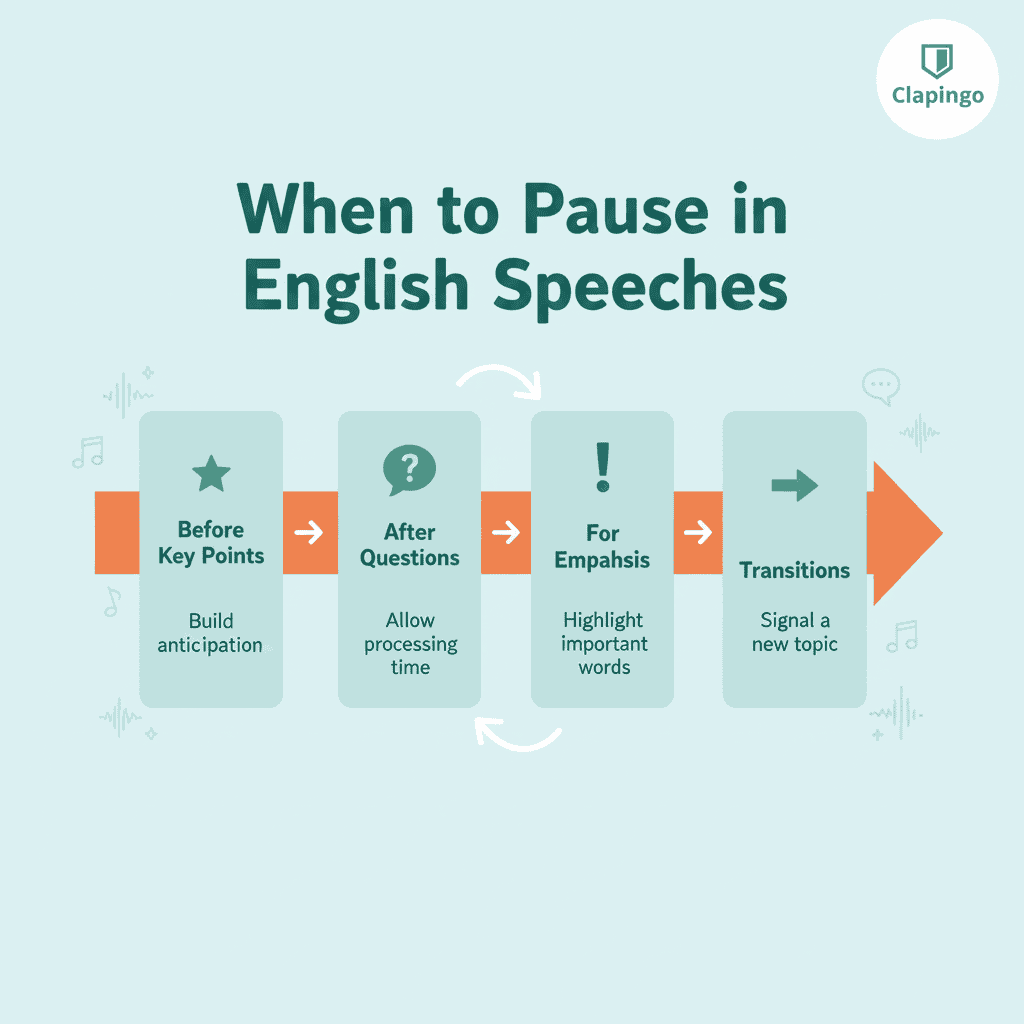
Different pauses serve different goals. Here’s how to use them strategically.
🎤 Clapingo Tip: Practice a 90-second speech using at least three different pause types. Record it. Notice how your delivery feels more dynamic.
Mastering Speech Rhythm: How to Sync Words, Pauses, and Emotion
Speech rhythm is the heartbeat of communication — a balance of speed, tone, and silence.
The Formula for Natural Rhythm
Chunk ideas: Speak in short thought groups (10–12 words max).
Pause intentionally: End each group with a small pause.
Vary length: Mix short and long pauses for contrast.
Sync emotion: Pause longer during emotional or serious parts.
Example:
“Leadership is not about authority… it’s about responsibility.
Responsibility… to act, to decide, to inspire.”
Each pause adds rhythm — turning words into music.
How Pauses Make You Sound More Confident
When you pause, you’re silently saying: I’m in control.
Rushed speakers seem nervous. Calm speakers command the stage.
Confidence Cues from Pausing
Steady breathing: Allows controlled delivery.
Less filler words: “Um” and “like” disappear when you pause intentionally.
Better pacing: Your speech sounds measured, not frantic.
Increased authority: You appear thoughtful and deliberate.
💡 Try This: Record yourself saying a 30-second pitch twice — once without pauses, once with pauses. The second version will sound 10x more confident.
Body Language and Silence: What Happens When You Stop Talking
Silence amplifies non-verbal communication. During a pause, your body speaks louder than words.
How to Use Pauses with Body Language
Maintain eye contact during pauses to build connection.
Use open gestures — hands relaxed, shoulders down.
Avoid nervous fidgeting; stay still and composed.
Smile softly after reflective pauses to add warmth.
Clapingo Insight: In live sessions, trainers often use role-plays to help learners match pauses with gestures, especially useful for presentations and interviews.
Using Pauses to Connect with Global Audiences
When speaking English in international or cross-cultural contexts, pacing becomes even more important.
Listeners with different accents or language backgrounds rely heavily on rhythm and pauses to follow along.
Tips for Global Communication
Use shorter sentences with frequent mini-pauses.
Emphasize key words slowly.
Pause before introducing unfamiliar terms.
Watch for visual cues (nods, smiles, confusion).
Pauses bridge linguistic gaps, making your message universally clear.
Clapingo’s Approach: Turning Pauses into Professional Presentation Skills
Clapingo is India’s leading spoken English platform, where users learn how to think, speak, and present confidently in English through 1:1 live sessions.
How Clapingo Helps You Master Pausing
Personalized feedback: Coaches analyze your delivery, highlighting pause placement and speech rhythm.
Real-world practice: Engage in mock presentations and storytelling sessions.
Confidence drills: Learn to replace filler words with silence.
Progress tracking: Measure improvement across multiple sessions.
🗣️ Clapingo Example Exercise:
Your trainer gives you a 2-minute topic. You must deliver it using all six pause types. Then, receive feedback on your timing, pacing, and confidence.
Step-by-Step Practice Drills
Drill 1: Script Marking
Write your script and insert pause indicators:
/= short pause//= medium pause///= long pause
Example:
“Public speaking is an art // not a skill // and every artist /// needs rhythm.”
Drill 2: Stopwatch Practice
Time your pauses.
Aim for consistency: short (1 sec), medium (3 sec), long (5 sec).
Drill 3: Audience Feedback
Practice live with a friend. Ask which moments felt powerful — those are your best pauses.
Drill 4: Mimic the Masters
Watch a TED Talk. Transcribe 1 minute. Mark pauses. Rehearse it in your own voice.
Avoid These Common Mistakes While Pausing
✋ Remember: Silence isn’t awkward unless you make it awkward.
Advanced Techniques: Combining Pauses with Vocal Variety
When paired with tone, pace, and emotion — pauses create storytelling magic.
3 Ways to Elevate Your Delivery
Pause + Lower Pitch: Command authority.
Pause + Softer Voice: Build intimacy.
Pause + Smile: Signal positivity or humor.
The “Clapingo Power Pause” Formula
Pause → Breathe → Gesture → Continue
Practicing this rhythm helps speakers control anxiety and project composure.
Famous Examples: Leaders Who Mastered Silence
Barack Obama: Used pauses for emotional weight (“Yes, we can…”)
Steve Jobs: Paused before revealing new Apple products — suspense built excitement.
Priyanka Chopra: Uses pacing and pauses effectively in global interviews.
Mahatma Gandhi: His quiet delivery made every word land with moral force.
Each mastered the art of timing — not just talking.
Did You Know?
93% of communication is non-verbal — pauses are part of that.
The average speaker pauses every 12–15 words in effective delivery.
TED speakers use approximately 30–45 seconds of silence in a 10-minute talk.
The human brain retains up to 60% more information when speakers pause strategically.
The Science Behind Pauses — What Happens in the Brain
Silence isn’t just dramatic; it’s neurological.
When a speaker pauses, the audience’s brain gets a moment to process the message and anchor emotional weight. This moment of quiet triggers deeper cognitive processing, helping listeners remember your words more effectively.
Research from communication psychology shows that well-timed pauses can improve listener retention by up to 30% compared to continuous speech.
So, every pause you make isn’t empty — it’s a powerful neurological tool that helps your message sink in.
Clapingo Pro Tip: Before an important line, pause for one second. Watch how the attention in the room heightens instantly.
The “Pause Triad” — Three Levels of Silence to Master
Just like music, pauses come in layers. Here’s a quick breakdown:
By mastering this “Pause Triad,” you’ll turn every silence into an intentional performance choice. It adds rhythm to your speech and makes you sound composed and confident.
Pausing as a Tool to Control Pace and Nerves
One of the most underrated effective speaking techniques is using pauses to manage stage fright.
When nerves kick in, speakers tend to speed up unconsciously. Strategic pauses force you to breathe, slow down, and recenter your thoughts.
The result? You appear calm, confident, and in control — even when your heart is racing.
Try this Clapingo exercise: Record a 60-second introduction of yourself, intentionally adding a 1-second pause after every sentence. Replay it. You’ll notice your speech feels more structured and powerful.
How Great Speakers Use Silence as a Signature Move
Every world-class speaker has a unique relationship with silence.
Barack Obama uses pauses to emphasize empathy.
Steve Jobs used them to create drama before big reveals.
Oprah Winfrey uses silence to show reflection and emotional authenticity.
The takeaway? Silence amplifies personality. It doesn’t mute you — it magnifies your presence.
When you use pauses intentionally, you transform from a “speaker delivering content” into a storyteller commanding attention.
How Pauses Shape Speech Rhythm in English
In English, rhythm is everything. It’s not just what you say but how you time it.
Pauses define speech rhythm, creating a natural flow that keeps listeners engaged.
Think of English as a song: consonants are the beats, vowels are the melody, and pauses are the rests that make it beautiful.
By adjusting your rhythm, you make your speech sound authentic, confident, and emotionally intelligent — qualities every great communicator needs.
Clapingo Practice tip: Watch a TED Talk and note every pause. You’ll notice speakers rarely talk for more than 7–10 seconds without a break.
The Cultural Role of Silence in Communication
In cross-cultural communication, silence carries different meanings:
In Western cultures, it often signals thoughtfulness or confidence.
In Asian cultures, it can show respect and active listening.
In Indian contexts, it may represent humility or careful consideration.
Understanding these nuances can help you use public speaking pauses appropriately in global settings — especially if you work in international teams or virtual presentations.
Clapingo’s trainers often highlight this when coaching learners who want to speak confidently in cross-border meetings.
Avoiding the “Dead Air” Trap — When Silence Feels Awkward
Not all pauses are created equal.
Too much silence can feel like you’ve lost your train of thought or forgotten your lines.
To avoid this, combine pauses with non-verbal cues — eye contact, gestures, or a small smile. These cues keep the audience comfortable while maintaining your control over the moment.
Remember: A pause paired with a confident posture is power. A pause paired with panic is a problem.
Training Your Pause Reflex — Daily Exercises
Becoming comfortable with silence takes deliberate practice.
Here are 3 short daily drills to build your pause confidence:
🎤 Mirror Talk: Speak about your day for 60 seconds, inserting a pause every 10 seconds.
⏱️ Power Countdown: Pause for 2 seconds before every new point in your next meeting.
🎧 TED Mimicry: Listen to a TED Talk and repeat it, copying the speaker’s pauses.
Over time, these drills make pausing feel natural — not forced. And as you refine your speech rhythm, your presence becomes effortlessly magnetic.
Tips and Tricks for Perfecting Pauses
✅ Record yourself daily for 2 minutes — analyze where natural pauses appear.
✅ Replace “uh” and “um” with 1-second silences.
✅ Use pauses to emphasize numbers, contrasts, and calls to action.
✅ Don’t over-rehearse — pauses must sound spontaneous.
✅ Watch stand-up comedians — they’re masters of timing and silence.
Conclusion & Call to Action
Silence is not the absence of speech — it’s the amplifier of meaning.
When you master public speaking pauses, your words gain gravity. You speak with rhythm, confidence, and grace.
Whether you’re preparing for a business presentation, a TED-style talk, or simply want to sound more confident in English, learning when to pause is your secret edge.
And you don’t have to do it alone — Clapingo gives you personalized, real-time guidance from expert mentors who help you polish every pause and perfect every sentence.
Ready to sound confident and command any stage?
Visit Clapingo.com today to book your live session and start transforming your English presentation skills.
Read Also: Confidently Communicating: Proven Techniques for Practicing and Improving Public Speaking in English