English for Freelancers: 10 Ways To Land International Clients and Projects
Master “English for freelancers” to win global clients. Learn freelance marketplace English, Upwork English tips, Fiverr communication strategies, and how to write winning client proposals.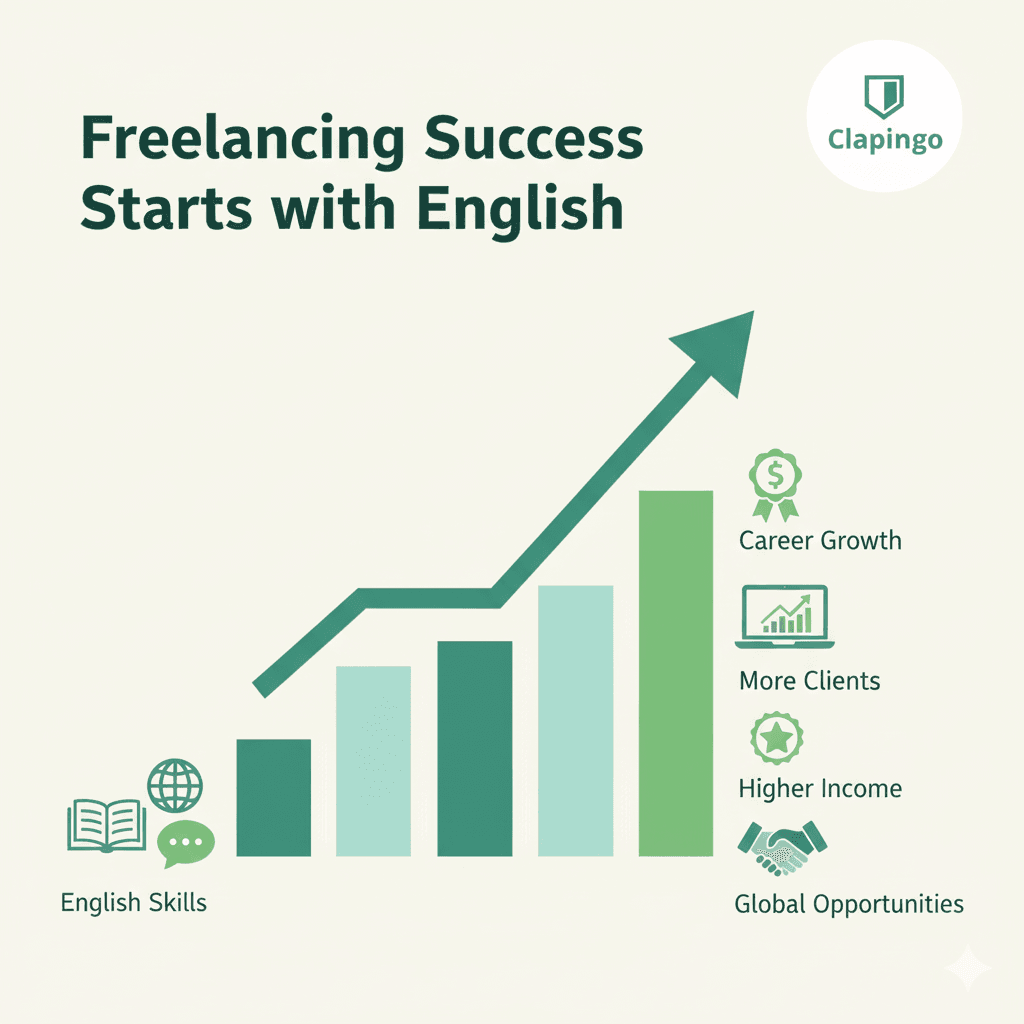
If you are a freelancer in a non-English speaking country, you may already sense this: your technical skills are solid, but when it comes to connecting with global clients, English for freelancers becomes a major differentiator. Whether you bid on Upwork, Fiverr, or other global marketplaces, your ability to communicate clearly, write compelling proposals, and maintain smooth client conversations can make or break your success.
In this post, we’ll dive deep into freelance marketplace English, Upwork English, Fiverr communication, and client proposals — all aimed at helping you land international clients and projects. We’ll also show how using a platform like Clapingo can accelerate your progress. Let’s begin.
Why “English for Freelancers” Matters
1. The global freelancing landscape
Over the past decade, freelancing has grown dramatically. Platforms like Upwork, Fiverr, Freelancer.com, and others have enabled individuals around the world to connect with clients across borders. This ecosystem is often called “e-lancing” or online freelancing.
But these platforms are primarily English-centric. Most clients post tasks in English, expect proposals in English, and prefer communication in English. If your English is weak or unclear, clients may discount your professionalism or struggle to work with you.
2. The gap between technical skill and communication skill
Many freelancers focus heavily on refining their technical or domain skills (web development, design, content writing, marketing, etc.). Yet they overlook communication—especially English. A great developer with poor English may lose a gig to a less skilled but more communicative freelancer.
Thus, English for freelancers is not a soft or optional skill. It is a core competency for success in international markets.
3. Business English ≠ everyday English
Many freelancers can speak everyday English or handle casual conversations. But business English / freelance marketplace English demands more: clarity, professionalism, proper tone, structure, and precision. It includes writing proposals, negotiating scopes, clarifying requirements, resolving misunderstandings, and maintaining client trust.
In short, mastering English in the freelance context puts you ahead.
Understanding “Freelance Marketplace English”
When you log into Upwork or Fiverr, what you see is more than just a job board — it’s a language marketplace. Let’s break down what “freelance marketplace English” means.
1. Key features of marketplace English
Conciseness: Clients often read dozens of proposals. You must get your point across in fewer, crisp sentences.
Client-centric tone: Talk about what you can do for them, not just your own history.
Clarity in deliverables and scope: Clients dislike ambiguity. Be explicit (e.g. “You will receive three design mockups, one revision, and final files in PNG & SVG”).
Polite but assertive style: Use standard sign-offs, greetings, professional phrases, and avoid overly casual slang.
Good grammar and spelling: Even small errors can hurt impression.
Cultural sensitivity: Clients can come from any country — understand how to adjust tone and avoid idioms that may confuse them.
2. Common pitfalls in marketplace English
Generic proposals that look copy-pasted
Overlong cover letters that no one reads
Vague deliverables or missing scope
Poor client follow-ups or silence
Misunderstanding client brief due to language gaps
By consciously working on freelance marketplace English, you reduce friction and stand out.
The Role of Upwork English & Fiverr Communication
Let’s look at two of the biggest freelancing sites: Upwork and Fiverr. Each has its quirks, and language plays a central role.
1. Upwork English
On Upwork, you often bid for projects via proposals, participate in interviews, and discuss requirements over messaging or video calls. Here are key points for Upwork English:
Proposals matter deeply: The first 1–2 lines are critical, as many clients skim or decide quickly.
Use the client's name or mirror their tone: This builds rapport.
Show that you read the job post: Mention specifics or ask a clarifying question.
Be confident, not needy: Avoid weak phrases like “I think” or “I hope.” Use “I will,” “I can,” “My deliverables include …” etc.
Negotiation phrases: When negotiating, back your rate with logic (“market rate survey,” “value delivered”) and use assertive, polite language.
Documentation & clarity: Always restate project milestones, deliverables, revision policy, payment terms.
Insights from real freelancers
From a Reddit thread:
“Clients only see the first 1-2 sentences of your cover letter, so make sure those are good.” Reddit
Clapingo Pro Tip: Hook them immediately.
2. Fiverr communication
Fiverr follows a gig model: you define your service, clients pick it, and then you talk. But communication still matters.
Gig description clarity: Use simple, clear language so clients know exactly what they get.
Deliverable definitions: Spell out what formats, how many revisions, timelines.
Pre-order questions: Ask clarifying questions up front to avoid misunderstandings.
Message responses: Be prompt, polite, and concise.
Revision requests: Use neutral language and don’t sound defensive.
Unlike Upwork, there’s often less back-and-forth in proposals, so your initial communication must be sharp.
3. Upwork vs Fiverr: Language tradeoffs
Given these differences, your English for freelancers approach must adapt depending on which platform(s) you use.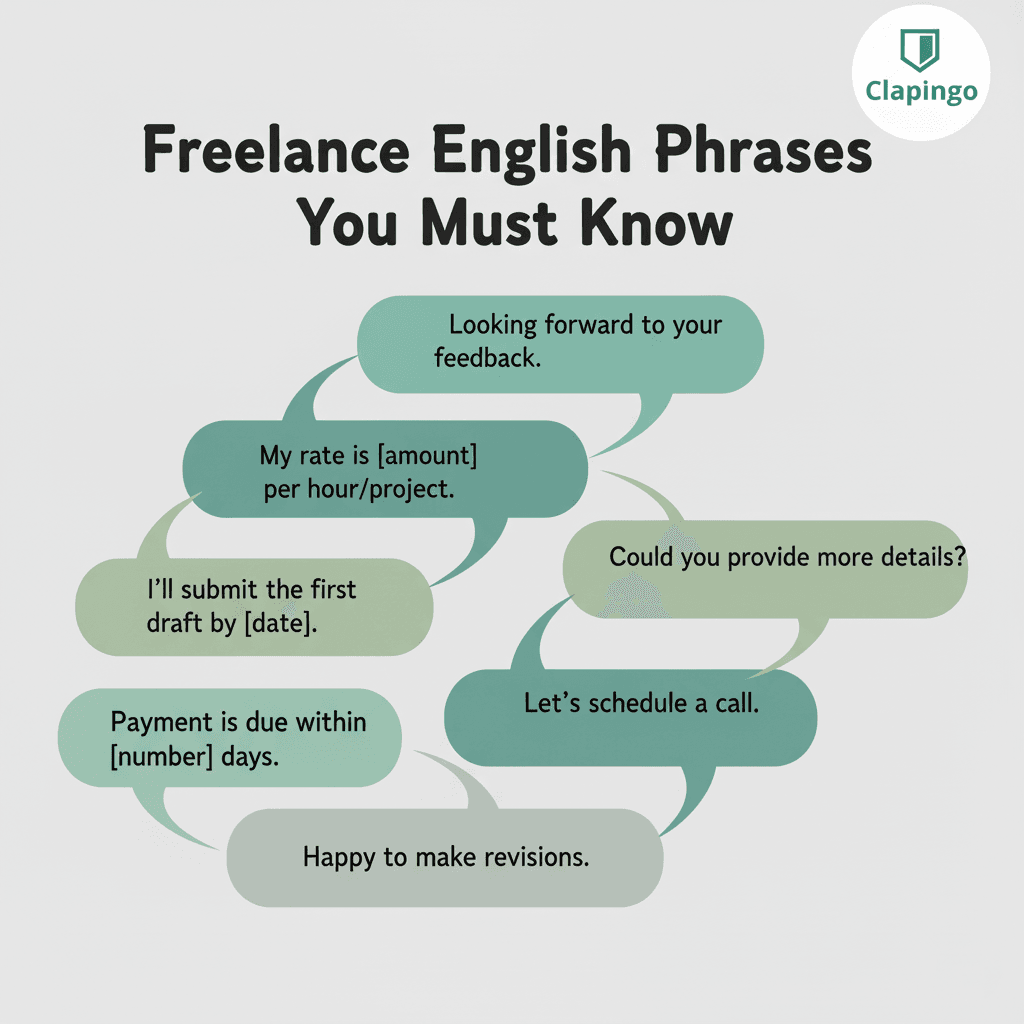
How to Improve Your English for Freelancing
If your English is currently just “okay,” don’t worry — you can improve it with deliberate practice. Here’s a roadmap.
1. Immersion & content consumption
Read business blogs, industry news, English articles relevant to your niche.
Watch YouTube videos, webinars, and TED talks in English — especially those in your field.
Listen to English podcasts related to freelancing, business, or your technical niche.
Use subtitles to help you follow, and pause to note phrases you like.
2. Structured learning & correction
Use grammar & writing tools (Grammarly, ProWritingAid, etc.) to check your writing.
Get feedback from native speakers, language partners, or mentors.
Take courses focused on business English or English for freelancers.
Focus on business vocabulary and phrases (negotiation, project scope, deliverables).
3. Practice active writing and speaking
Draft mock proposals and freelance emails, then compare with sample ones.
Role-play client conversations: ask questions, give estimates, resolve scope changes.
Speak out loud: read your proposals or messages before sending.
Think in English: narrate your project plan, your to-do list, and client messages in English in your head.
The more you actively produce English (not just passively read), the faster you’ll improve.
4. Focus on clarity over perfection
Many learners worry about perfect grammar. But in freelancing contexts, clarity and brevity are often more appreciated than flawless sentences. Use shorter sentences, avoid complex constructions, and always revise before sending.
5. Use Clapingo to accelerate progress
This is where Clapingo comes in (more detail in Section 8). As a dedicated English-learning platform, Clapingo can help you practice, get feedback, and refine exactly the kind of business/freelance English you need. You can simulate client conversations, improve proposals, and gain confidence faster.
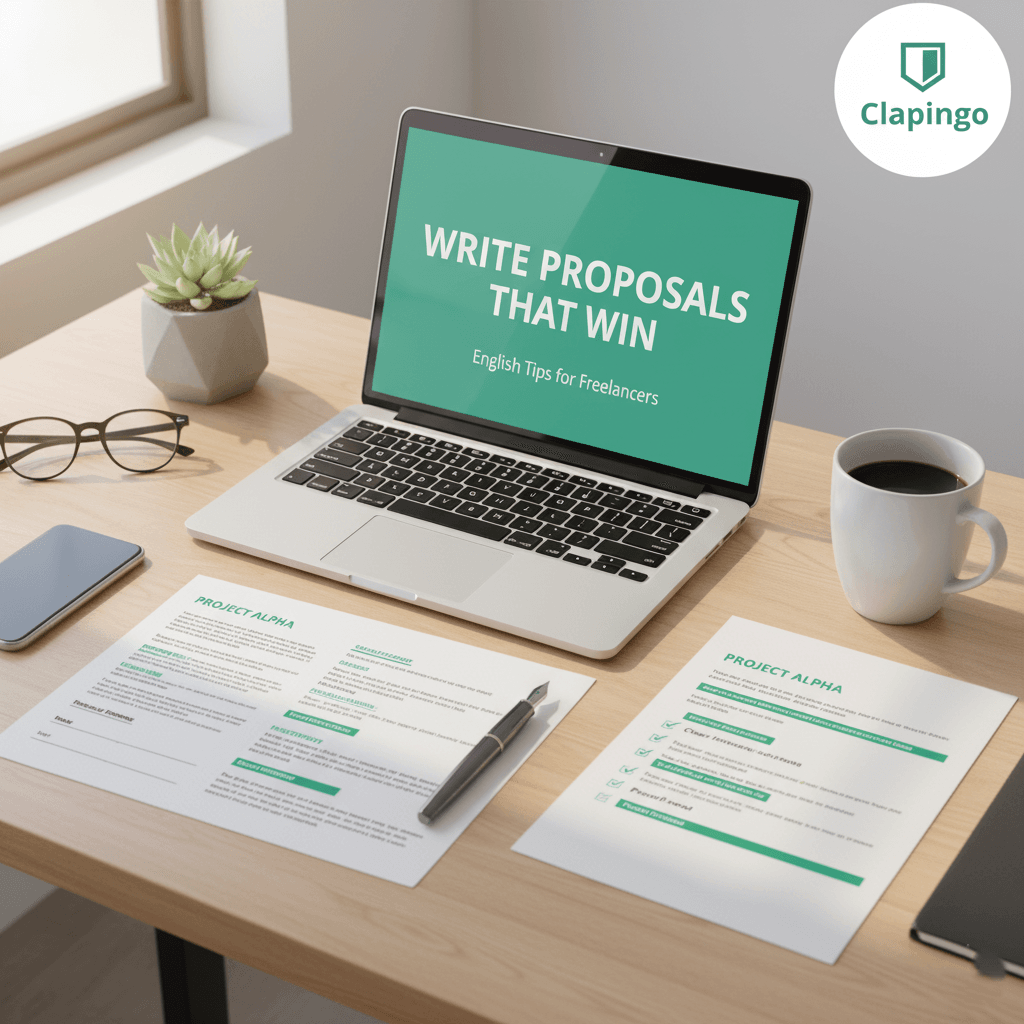
Writing Client Proposals That Win
One of the most decisive stages in landing international clients is the proposal. Let’s break down an effective strategy.
1. Proposal structure (and best practices)
A typical winning proposal includes:
Greeting + name reference
Hook / first sentence
Brief problem restatement
What you will deliver (scope)
Timeline & estimate
Why you’re the best fit
Call to action (e.g. suggest a call)
Closing
Best practices:
Keep proposals short (e.g. 150–250 words for Upwork).
Use bullet points to improve readability.
Personalize — never paste generic text.
Use the client's language / keywords / tone.
Include examples or portfolio links (relevant ones).
End with a clear CTA: “Shall we discuss this over a quick call?”
Avoid weak phrases like “I believe / I feel / I hope.” Instead: “I will / I am confident / I can.”
Ask 1–2 clarifying questions upfront.
2. Sample proposal (Upwork style)
Hi [Client Name],
I’ve read your requirement carefully — you want a responsive mobile app to track fitness goals, integrate with calendars, and show analytics.
Here’s how I propose to tackle it:
Module 1: user login, profile & onboarding
Module 2: tracking features + calendar sync
Module 3: analytics + reporting dashboard
I can deliver a prototype within 7 days, and final version in 3 weeks.
I’ve built two similar apps using React Native + Firebase. Here’s one: [link].
Want to hop on a 10-minute call so I can refine the scope and we can lock in a timeline?
Looking forward,
[Your Name]
3. Tips specific to Upwork English proposals
Use the client’s name or company name if known.
Lead with how you understand their pain or goal.
Mirror some phrases from their job description.
Provide confidence by referencing past relevant work.
Insert a clarifying question to spark conversation.
If new on Upwork, address it transparently: “Though I’m new here, I have X years in design, and here are external client reviews…”
4. Tips for Fiverr proposals/messages (or custom offers)
Start with appreciation: “Thank you for considering my gig.”
Restate what they need in your own words (to show you understood).
Clarify deliverables, timelines, and ask for necessary inputs.
Mention extras: “If you send me brand assets, I can deliver faster.”
End with a question or option: “Would you like a sample sketch first?”
Be proactive: If client seems uncertain, suggest a quick call or share a mock draft.
Writing proposals well is half the battle. With stronger freelance marketplace English, your proposals will convert more.
Communication Skills in Client Projects
Even after you win the project, your English (speaking, writing, tone) continues to matter during execution.
1. Kickoff / discovery calls
Prepare an agenda and share it ahead: “We’ll discuss scope, timeline, responsibilities, risks.”
Use clear signposts: “First … Second … Finally …”
Ask clarifying questions: “When you say ‘mobile-first design’, do you mean iOS, Android, or both?”
Paraphrase what the client says: “So you mean that the dashboard should show last 7 days’ performance — is that correct?”
Set expectations on communication channels, response times, milestones.
2. Mid-project updates and reporting
Send structured updates: bullet points, status summary, completed tasks, pending items, blockers.
Use visuals (screenshots, mockups) to reduce ambiguity.
Be concise and polite: “Here is what’s done.”
If delays or issues arise, admit early and propose mitigation.
3. Handling scope changes / feedback
Always acknowledge the feedback first: “Thanks for the input. I see your point about …”
Clarify the change: “Just to confirm — you want to add a login via social media? That’s an additional task, so the timeline shifts by 2 days.”
Use neutral, professional language, not defensiveness.
4. Negotiations & pricing in English
Do your homework: know market rates for your skill level.
Use polite assertive phrases: “Based on the scope, my rate is $X,” “I am open to discussion, but the minimum I can do is …”
Always justify: “Because I will provide full testing, maintenance, and documentation.”
Offer choices: “You can go for Plan A (faster, higher cost) or Plan B (slower but cheaper).”
Use deadlines: “I can reserve this slot for you, but I’ll have to reallocate if we delay beyond Tuesday.”
5. Closing projects & maintaining clients
At project end, deliver a summary of work, what’s next, and maintenance options.
Ask for feedback or testimonials in a polite way.
Suggest future work or upsells.
Keep occasional check-ins: “Hope the solution is working well; if anything changes, I’m ready to help.”
Throughout, your English must remain clear, professional, and responsive — that builds trust.
Using Clapingo to Strengthen Your English
Clapingo is an online platform for English learning and speaking practice (especially tailored for students and professionals). Here’s how freelancers can leverage it to grow faster in English for freelancers.
1. Why Clapingo fits freelancers
You can have one-on-one spoken English sessions tailored to your freelance communication needs.
Trainers can help you role-play client calls, give feedback on tone, fluency, clarity.
You can simulate proposal writing and editing sessions — get instant corrections and suggestions.
It offers flexible timings, so you can learn around your freelancing schedule.
Over time, your confidence in Upwork English, Fiverr communication, negotiation, and client calls improves.
2. Suggested Clapingo workflows for freelancers
3. How to integrate Clapingo sessions into your routine
Schedule 1–2 sessions per week dedicated to client communication practice.
Before each session, prep your real or prospective proposals/messages.
Ask your trainer to role-play as a difficult client or skeptical one.
Record your conversations (with permission) and replay lessons.
Over weeks, measure your improvement by monitoring client feedback or conversion rate from proposals.
Clapingo can be your personalized accelerator in leveling up freelance marketplace English and client-facing communication.
Strategies to Land International Clients
Beyond just writing proposals and improving English, you need strategies to actually land and retain clients. Here are proven ones.
1. Build a niche and specialization
Clients often prefer specialists over generalists. If you say, “I do everything,” you dilute your appeal. Instead, choose a niche (e.g. e-commerce sites, health & fitness, WordPress, fintech) and speak the vocabulary of that niche in your proposals and communication.
When you use domain-specific terms confidently, clients feel you understand their world.
2. Optimize your freelancer profile
Use a strong headline with your niche + “English for freelancers” mindset (e.g. “E-commerce developer who writes clean, clear proposals in English”).
Write a profile summary that highlights communication strengths alongside technical ones.
Showcase work samples that show not only technical deliverables but client communication, documentation, walkthroughs, etc.
Encourage clients to leave feedback specifically about your clarity and responsiveness.
3. Use “small wins” to build trust
Especially when starting internationally, accept small, manageable assignments (with clear communication) to build reputation. Over-deliver on them so clients leave glowing reviews emphasizing how smooth communication was. That gives you social proof that your English is client-friendly.
4. Leverage social proof and case studies
Create short case studies (1–2 paragraph) with client context, challenge, your solution, results, and communication notes (“We discussed over three calls; I gave weekly updates”).
Ask clients to comment on how communication and clarity were in testimonials.
Use these in your proposals subtly: “As in client X project, where I delivered on time and kept weekly digest emails, I can do the same for you.”
5. Proactive outreach & content marketing
Publish short blog posts or LinkedIn articles in English in your niche, sharing insights. Prospective clients find you through that content.
Share mini how-to videos or tips (in English) to show your communication flair.
Network in freelancer groups, respond to posts with helpful answers — clients see your clarity first.
6. Referral / repeat clients
Once you have a few international clients, maintain them and ask for referrals. Repeat clients reduce the stress of proposal writing and allow you to focus on execution. Your clear English communication keeps them coming back.
Overcoming Common Challenges
No journey is flawless. Here are common challenges freelancers face with English for freelancers and how to overcome them.
1. Fear of making mistakes / hesitation
Many freelancers freeze because they fear grammatical mistakes or sounding “not native.” But most clients care more about clarity and delivery than perfect grammar. Use shorter, simple sentences when unsure, and gradually expand.
2. Native clients with different accents / idioms
You may understand Indian English, but a client from the US, UK, or Australia may speak differently. To adapt:
Listen actively and don’t hesitate to ask: “Can you clarify what X means?”
Note unfamiliar phrases and search them later
Practice with diverse English media (videos, podcasts from various countries).
3. Juggling language learning with client work
Time is always scarce. Here’s how to balance:
Allocate small daily slots (e.g. 15 minutes) for vocabulary or reading.
Use Clapingo during slow client hours.
Make your client communication your practice: draft more carefully, review messages aloud, learn from each feedback.
Use templates (but adapt them), so you reduce brain drain when writing proposals.
4. Dealing with communication misunderstandings
Sometimes miscommunication happens. When it does:
Politely clarify immediately (“Just to confirm, by ‘XYZ’ do you mean … ?”)
Use visuals (screenshots, diagrams) to resolve ambiguity
Apologize if needed, and propose a fix rather than arguing.
Document changes so there is a trace.
5. Scaling too fast / losing communication quality
As you gain clients, your workload may grow. But do not let your English or clarity slip. Consider:
Using templates / checklists for project kickoff, updates, messages
Hiring or collaborating with someone to proofread proposals
Only accepting new clients when you can maintain communication standards
By being proactive, you protect your reputation.
Tips, Tricks & Best Practices
Here’s a consolidated list of actionable tips & tricks to boost your success.
Mirroring technique: Use phrases from the job post or client’s message to echo that tone.
Subject lines matter: Use project name or benefit in message subject, e.g. “Proposal for Mobile App – 10-day prototype.”
One question per message: Limit your request for clarification to one major question, else clients may delay.
Use headings / bullets: Long blocks of text discourage reading.
Use "signposts": like “Here’s how I’ll proceed…” or “In summary…”
Proofread out loud: Your ears catch problems your eyes miss.
Have a “proposal register”: Keep a file of your past proposals, proposals that succeeded, and poor ones. Review monthly.
Track reply times: Respond within 24 hours (ideally sooner).
Avoid slang / idiomatic phrases when in doubt.
Send mid-day messages: Some clients wake up in different time zones; midday messages may get attention.
Set expectations early: “I reply within 2 business hours on weekdays.”
Celebrate linguistic progress: Revisit old proposals and see how much your English has improved.
Did You Know?
Did you know that 75% of clients in global freelance marketplaces list communication clarity as one of the top criteria when choosing a freelancer?
Did you know that many top Upwork clients reject proposals before reading them fully, simply based on first impression or poor English in opening lines?
Did you know that non-native English speakers who use structured business English often outperform many native English speakers whose communication is sloppy?
Did you know that Clapingo has tailored sessions for professionals and freelancers, not just students? This means you can practice real-world writing, calls, and emails.
Conclusion
Learning English for freelancers, mastering freelance marketplace English, polishing your Upwork English and Fiverr communication, and writing winning client proposals are not optional extras — they are core weapons in your freelancing toolkit.
Each section above gives you strategies you can act on today:
Improve your English through immersion, practice, and using Clapingo
Write crisp, client-centric proposals
Communicate clearly during project execution
Build trust, reputation, and international relationships
If you commit to continuous improvement, track your response rates and client feedback, and keep refining, you’ll see your international freelance business grow steadily.
Read Also: Breaking Down Barriers: Importance Of Spoken English As A Global Bridge Language